Here's the cover for the UK version of The Soldier - first books of Rise of the Jain. There's more about this here over on Macmillan Tor.
Friday, September 29, 2017
Saturday, September 23, 2017
Macmillan Doing Stuff
So anyway, here's a thing: Macmillan are doing all sorts of good stuff. First there are my books appearing on Audible UK. Second, the one you don't know about till right now, is they're doing new covers for my backlist for another push on them. I've seen these covers and they are pretty damned cool. First up will be the Cormac books...
And here, for your listening pleasure, are soundcloud links to those books that are now up on Audible UK:
Thanks Macmillan!
Wednesday, September 20, 2017
Who Reads my Books: David Chapman
Hi,
I started the whole Sci-Fi/Fantasy thing as a spotty nerdy teenager. Managed to lose the spots and teens, still a nerd! Cut my teeth as many of us do on Asimov, Clarke and Heinlein. Flirted slightly with the extremely misogynist John Norman and his planet Gor (I was a teenager!) and the “esteemed” Ron Hubbard. I later diversified to Sci Fantasy and remember devouring the Belgarion series by Mr and Mrs Eddings. I had an open order for every book as it came out. I still have quite a collection of hard copy books but nowadays most books are “Kindled” on the Ipad.
I got into Richard Morgan’s early books a few years ago and while waiting for the next in the series looked around for similar genre, found the Polity, and was converted! I love the whole Polity universe as it is painted on such a large canvas, there’s blood, gore and hydraulic fluid aplenty but generally Neal’s tone is one of optimism (As long as you don’t let the humans control anything critical). I also find listening to the audio versions an excellent way of covering large distances in the car without being bored to insensibility. Neal, thanks for the mental pictures, whether it’s C or Si based, you flesh (HiCr) out a character superbly. While waiting on the next polity instalment, I’m revisiting Gemmell and Pratchett, both sorely missed.
As for myself, I trained as a foundry engineer at college, left knowing everything and that I was the pinnacle of evolution. One week on the shop floor in a heavy steel foundry soon sorted that out! I started as a technician and worked myself up through production and then into sales. Covered steel, iron, aluminium and nonferrous alloys, die casting, moulding, investment casting and MIM before moving into the black art of metal powder manufacturing.
Anybody who has been associated with foundries will know our aversion to extremely hot metals combined with water. So when it was first explained to me during the factory tour that they atomise a 1650 C metal stream with high pressure cold water, my first instinct was to run!
Fortunately I stayed and moved into the position of Sales Director and got to learn so much about pressing metals, filtered metals and my favourite the spraying of metal powders. Who cannot be impressed watching a -53µm superalloy powder being sprayed through a miniature jet engine at multiple Mach!
I worked within the engineering group for over 10 years before it was sold to an “Entrepreneur” who wanted to take us all back to “grass roots” Translation, stop trying to stay on the leading edge and make lots of simple things that can be copied and made cheaper in other countries. Ah, the foresight!
I left and the group was bust in 12 months
As many do when we can’t fall back to a real job immediately, I became a consultant! One contract involved doing due diligence on an obscure metal powder company in the middle of Slovakia. I had an option of this or a similar company in Oslo. I had spent most of my commercial life working in Asia and West Coast USA. I hate the cold! Due to an incredible lack of geographical knowledge, I presumed the town in Slovakia with the same latitude as Paris would be a better option in December than Norway. Brilliant deduction, I arrived in Zilina "International" (2 flights a week only to Prague!) Airport on the 19th December 2005 to find out that the temperature of -27C did exist outside the polar regions, f***king Oslo was +6C!!
At this time, Slovakia was still very “Socialistic” - grey concrete buildings, no colours aside from the candle lit cemeteries, and of course a metre of bloody snow everywhere. I was slightly surprised therefore to find that my source of more appropriate hat and gloves was a bloody big white building with Tesco writ large on the side. Despite this, the people were lovely even if the factory was tired, unkempt and downright dangerous in areas. I did the due diligence, I reported back and the German company I was working for, purchased the complete site.
A couple of months later I was tasked with going there as a technical consultant for a 3 month contract, 11 years later I’m still here (must cancel that return flight!) now a Managing Director and have never been so content.
I have a lovely house in the village with my very own mountain! The people are still lovely although the language is an utter bastard (Slovaks are SO proud of this), we now have a modern, productive and profitable company and a management team second to none.
I’m still a nerd, and as I’m a totally selfish bastard I live on my own. I still enjoy messing around with computers and playing with the latest available tech. In the UK I was heavily into car restoration and car building but nowadays the idea of a 5 speed gearbox crushing my nagers whilst laying on a cold concrete floor doesn’t have the appeal, I’m getting soft.
One of my first projects during the house reconstruction was to convert one of the garages into a model railway room, if it’s good enough for Rod Stewart it’s good enough for me. Always wanted one as a kid and as I now have the space, money and total selfish indulgence, I can allow my inner child to run free. Of course I tie it in to computer / tablet control / remote access etc.
Holidays in Asia and/or South France are still enjoyable, weekends working on small trains or in the garden, life is good!
Oh and the liking for warm climates? It got down to -30C in the village this Winter! ;-)
David Chapman
Dolny Kubin
Slovakia
I started the whole Sci-Fi/Fantasy thing as a spotty nerdy teenager. Managed to lose the spots and teens, still a nerd! Cut my teeth as many of us do on Asimov, Clarke and Heinlein. Flirted slightly with the extremely misogynist John Norman and his planet Gor (I was a teenager!) and the “esteemed” Ron Hubbard. I later diversified to Sci Fantasy and remember devouring the Belgarion series by Mr and Mrs Eddings. I had an open order for every book as it came out. I still have quite a collection of hard copy books but nowadays most books are “Kindled” on the Ipad.
I got into Richard Morgan’s early books a few years ago and while waiting for the next in the series looked around for similar genre, found the Polity, and was converted! I love the whole Polity universe as it is painted on such a large canvas, there’s blood, gore and hydraulic fluid aplenty but generally Neal’s tone is one of optimism (As long as you don’t let the humans control anything critical). I also find listening to the audio versions an excellent way of covering large distances in the car without being bored to insensibility. Neal, thanks for the mental pictures, whether it’s C or Si based, you flesh (HiCr) out a character superbly. While waiting on the next polity instalment, I’m revisiting Gemmell and Pratchett, both sorely missed.
As for myself, I trained as a foundry engineer at college, left knowing everything and that I was the pinnacle of evolution. One week on the shop floor in a heavy steel foundry soon sorted that out! I started as a technician and worked myself up through production and then into sales. Covered steel, iron, aluminium and nonferrous alloys, die casting, moulding, investment casting and MIM before moving into the black art of metal powder manufacturing.
Anybody who has been associated with foundries will know our aversion to extremely hot metals combined with water. So when it was first explained to me during the factory tour that they atomise a 1650 C metal stream with high pressure cold water, my first instinct was to run!
Fortunately I stayed and moved into the position of Sales Director and got to learn so much about pressing metals, filtered metals and my favourite the spraying of metal powders. Who cannot be impressed watching a -53µm superalloy powder being sprayed through a miniature jet engine at multiple Mach!
I worked within the engineering group for over 10 years before it was sold to an “Entrepreneur” who wanted to take us all back to “grass roots” Translation, stop trying to stay on the leading edge and make lots of simple things that can be copied and made cheaper in other countries. Ah, the foresight!
I left and the group was bust in 12 months
As many do when we can’t fall back to a real job immediately, I became a consultant! One contract involved doing due diligence on an obscure metal powder company in the middle of Slovakia. I had an option of this or a similar company in Oslo. I had spent most of my commercial life working in Asia and West Coast USA. I hate the cold! Due to an incredible lack of geographical knowledge, I presumed the town in Slovakia with the same latitude as Paris would be a better option in December than Norway. Brilliant deduction, I arrived in Zilina "International" (2 flights a week only to Prague!) Airport on the 19th December 2005 to find out that the temperature of -27C did exist outside the polar regions, f***king Oslo was +6C!!
At this time, Slovakia was still very “Socialistic” - grey concrete buildings, no colours aside from the candle lit cemeteries, and of course a metre of bloody snow everywhere. I was slightly surprised therefore to find that my source of more appropriate hat and gloves was a bloody big white building with Tesco writ large on the side. Despite this, the people were lovely even if the factory was tired, unkempt and downright dangerous in areas. I did the due diligence, I reported back and the German company I was working for, purchased the complete site.
A couple of months later I was tasked with going there as a technical consultant for a 3 month contract, 11 years later I’m still here (must cancel that return flight!) now a Managing Director and have never been so content.
I have a lovely house in the village with my very own mountain! The people are still lovely although the language is an utter bastard (Slovaks are SO proud of this), we now have a modern, productive and profitable company and a management team second to none.
I’m still a nerd, and as I’m a totally selfish bastard I live on my own. I still enjoy messing around with computers and playing with the latest available tech. In the UK I was heavily into car restoration and car building but nowadays the idea of a 5 speed gearbox crushing my nagers whilst laying on a cold concrete floor doesn’t have the appeal, I’m getting soft.
One of my first projects during the house reconstruction was to convert one of the garages into a model railway room, if it’s good enough for Rod Stewart it’s good enough for me. Always wanted one as a kid and as I now have the space, money and total selfish indulgence, I can allow my inner child to run free. Of course I tie it in to computer / tablet control / remote access etc.
Holidays in Asia and/or South France are still enjoyable, weekends working on small trains or in the garden, life is good!
Oh and the liking for warm climates? It got down to -30C in the village this Winter! ;-)
David Chapman
Dolny Kubin
Slovakia
Tuesday, September 19, 2017
Monday, September 18, 2017
Book Sale: Transformation Trilogy
Friday, September 15, 2017
Who Reads my Books: Paul LaFontaine
I’m Paul LaFontaine, currently living in Breckenridge, Colorado. Love the mountains, skiing, hiking and the outdoors.
I grew up on classic science fiction that had been written 20 years earlier - Heinlein, A.C. Clark, Asimov. Even went really old school E.E. Doc Smith and the Lensman series. Ursula K. LeGuin’s the Lathe of Heaven. The Forever War. Consumed books on nuclear war, mutants, plagues. Always military themes. Fleets, dropship troopers, Mega-tanks, mushroom clouds.
In 1980 I read a novelette in Omni magazine by a then little known writer named George R.R. Martin called Sandkings. My love of bio-based science fiction, kindled by the Bugs in Starship Troopers, was stoked into a roaring inferno by Martin’s Sandkings that would inevitably lead me to a bunch of crabby characters on a certain moon in the future.
My first human science fiction hero was Bel Riose, the hapless General in the failing Empire of Asimov’s Foundation Trilogy. Unstoppable when in command of his legendary 20th Fleet, the politicians ended his career. Aware of the thematic similarities only dimly as a teenager, I applied to and attended the United States Military Academy to become an officer in the Army of another empire in its twilight.
After deploying and participating in the First Gulf War and seeing how grimy and random war can be, I got out and tried business. Not particularly lucky or skilled, I was swept up into a bit of momentum when the internet happened. I got my first taste of the new capabilities that made Artificial Intelligence conceivable. I saw things at scale. Fast forward past a bunch of boring business stuff and I find myself sent to the UK to help build out the internet arm of the benevolent and beloved Ticketmaster. And it all began to come together - love of bio based science fiction, interest in AI and located in the UK where I was one short visit to a Waterstone’s away from crossing paths with Neal Asher’s work.
My first of Neal’s books was Gridlinked. I was blown away. Ian Cormac was a character I really connected with. The Polity had it all. AI, Golems, Sparkind, battle wagons, weird tech and critters of all types. Bless the Prador and the little children. Beware the Brass Man. Enjoy the creepy belly feel of picturing the reified Sable Keech.
I’ve read every book of Neal’s I can download. And that makes for some good reading.
I had a proud papa moment when my 24 year old son sent me a photo as he was deploying to the Middle East to participate in operations there. He took a pic of two books he had picked up for his trip. One was Dan Simmon’s Hyperion (a good one), and the other was Neal’s War Factory. A staple. I have taught him well.
Thanks Neal for your work!
I grew up on classic science fiction that had been written 20 years earlier - Heinlein, A.C. Clark, Asimov. Even went really old school E.E. Doc Smith and the Lensman series. Ursula K. LeGuin’s the Lathe of Heaven. The Forever War. Consumed books on nuclear war, mutants, plagues. Always military themes. Fleets, dropship troopers, Mega-tanks, mushroom clouds.
In 1980 I read a novelette in Omni magazine by a then little known writer named George R.R. Martin called Sandkings. My love of bio-based science fiction, kindled by the Bugs in Starship Troopers, was stoked into a roaring inferno by Martin’s Sandkings that would inevitably lead me to a bunch of crabby characters on a certain moon in the future.
My first human science fiction hero was Bel Riose, the hapless General in the failing Empire of Asimov’s Foundation Trilogy. Unstoppable when in command of his legendary 20th Fleet, the politicians ended his career. Aware of the thematic similarities only dimly as a teenager, I applied to and attended the United States Military Academy to become an officer in the Army of another empire in its twilight.
After deploying and participating in the First Gulf War and seeing how grimy and random war can be, I got out and tried business. Not particularly lucky or skilled, I was swept up into a bit of momentum when the internet happened. I got my first taste of the new capabilities that made Artificial Intelligence conceivable. I saw things at scale. Fast forward past a bunch of boring business stuff and I find myself sent to the UK to help build out the internet arm of the benevolent and beloved Ticketmaster. And it all began to come together - love of bio based science fiction, interest in AI and located in the UK where I was one short visit to a Waterstone’s away from crossing paths with Neal Asher’s work.
My first of Neal’s books was Gridlinked. I was blown away. Ian Cormac was a character I really connected with. The Polity had it all. AI, Golems, Sparkind, battle wagons, weird tech and critters of all types. Bless the Prador and the little children. Beware the Brass Man. Enjoy the creepy belly feel of picturing the reified Sable Keech.
I’ve read every book of Neal’s I can download. And that makes for some good reading.
I had a proud papa moment when my 24 year old son sent me a photo as he was deploying to the Middle East to participate in operations there. He took a pic of two books he had picked up for his trip. One was Dan Simmon’s Hyperion (a good one), and the other was Neal’s War Factory. A staple. I have taught him well.
Thanks Neal for your work!
Tuesday, September 12, 2017
Transformation Trilogy on Audible UK
It seems that the first two books of the Transformation trilogy are now available on Audible UK read by Peter Noble. Infinity Engine will be there on October 5th.
Saturday, September 09, 2017
Gridlinked Free in Australia & New Zealand
Gridlinked free! This is a promotion for Australian and New Zealand readers. Gridlinked is free for one week, from yesterday, featured in iBooks First in a Series Free. Spread the word! Repost!
Thursday, September 07, 2017
Who Reads my Books: Benjamin Eriksen
I was born in 1975 and am still not dead. When I’m not sleeping, eating, teaching, fighting or seeing my girlfriend or my kids, I like to read weird books. Science fiction, esotericism, popular science, the obscure and arcane, general weirdness with hooks and jaw muscles that lock up and bleed you dry. Through the years I’ve been paid money to do different things, like selling people books, screaming at men dressed in camouflage, calling people named Chris (Wherever you need to call an office, ask for Chris. He knows EVERYTHING. Debt collection was no different. I’ve spoken to literally hundreds of people called Chris.) and trying to make kids believe in their ability to master the Oxford comma. I’m Ben. Hi.
I’ve been favourably likened to a crazed berserker, which is plainly a load of dingo’s kidneys. I do yoga and read books. I got hooked on science fiction in grade school, when one of my oldest and dearest friends and I would check out as many anthologies from the library as we could, and then spent afternoons throwing those books back and forth between each our sofa. The floor was lava. The books smelled like vanilla. Our minds reeled. He is a professor of organic chemistry today. I am a schoolteacher. Back then, we dreamed of travelling to distant worlds, building generational spaceships, breaking the lightspeed barrier, watching the event horizon of a black hole, time paradoxes, artificial intelligences, alien species, quantum physics and escaping a world’s gravity well by use of nanotube space elevators. We were ten.
Aged 15, I was given “The Hitchhiker’s Guide to the Galaxy” by Douglas Adams and laughed for a month. My mother would tell me she could hear me laughing through the wall and I had to go to school the next day, bright-eyed and bushy-tailed, or so help me. Twelve years later I wrote my Master’s dissertation on the canonicity of that book series, and I still can’t decide if it was a really clever piece of work or I was trying to shout louder than Adams’ detractors. Even his biographers insisted his works were nothing but light entertainment.
There’s a certain sensitivity to the hilarity of the almost irrationally grotesque that I’ve only found within the works of some very few authors, such as Adams, Iain Banks, Alfred Bester and of course Neal Asher. Too often, science fiction could become too drawn-out, too senselessly descriptive. As all the purists know, be they on the space opera or hard sci-fi side of the fence, the truly great science fiction is about humanity. And when you get right down to it, the history of humanity is a kaleidoscope of grisly, seemingly unbounded brutality, walking hand in hand with a very inappropriate sense of humour.
When I was little, my mother gave me a piece of advice that I never forgot. “You can do two things about life. You can laugh, or you can cry. Your choice.” Where I think Asher stood out from all the science fiction I voraciously consumed through my adult years was in how it transfixed me like a deer caught in a truck’s headlights, insecure about its future as a hood ornament. I had bought “The Gabble”. I had no clue.
For those of you not in the know (Shame on you. Seriously.), the Gabbleduck is an enigmatic, pyramidal life form that is arguably sentient, seemingly indifferent to other life forms and speaks in weird vocalizations that never. Ever. Repeat. It baffled me. There was an almost Lovecraftian horror to the Gabbleduck. It spoke of hidden horrors, a race that had collectively lobotomized themselves in an ancient conflict, for possibly draconian reasons. It was hilariously funny and mind-numbingly dreadful at the same time. It was like discovering that your kindly grandfather kept the livers of dead men in neatly labeled glass jars in a hidden room in his basement, and he invited you to inspect and admire his collection as he regaled you with the curious stories of how they ended up in his care, laughing with fondness and a twinkle in his eye. It was all for the glory of the Dread Voice from the Beyond. And here is my collection of rare, vintage toothpicks.
Needless to say, I read every single book I came across by Asher. I laughed. I was nauseated. I was intrigued. Sometimes I tasted that painful ache of existential angst that sometimes spills out, and curiously, on those occasions I’ve felt reassured as if by Neal’s own hand reaching out, telling me it’s OK. And it was better than OK. Even in an uncaring, senselessly brutal and frequently hilarious universe, it’s better to laugh than to cry. Shakespeare’s oft-quoted passage about life being a tale told by an idiot, full of sound and fury, signifying nothing is definitely not valid here.
On a related note, Shakespeare had so-called “trouble plays”, which defied categorization as either tragedy or comedy, somehow synergistically managing to create better comedy AND better tragedy at the same time. I like to think that Asher does something very similar in creating stories that straddle the gap between poignant tragedy and side-splitting comedy while still managing to keep their metaphorical trousers from splitting.
Keep writing books, please. I need them.
I’ve been favourably likened to a crazed berserker, which is plainly a load of dingo’s kidneys. I do yoga and read books. I got hooked on science fiction in grade school, when one of my oldest and dearest friends and I would check out as many anthologies from the library as we could, and then spent afternoons throwing those books back and forth between each our sofa. The floor was lava. The books smelled like vanilla. Our minds reeled. He is a professor of organic chemistry today. I am a schoolteacher. Back then, we dreamed of travelling to distant worlds, building generational spaceships, breaking the lightspeed barrier, watching the event horizon of a black hole, time paradoxes, artificial intelligences, alien species, quantum physics and escaping a world’s gravity well by use of nanotube space elevators. We were ten.
Aged 15, I was given “The Hitchhiker’s Guide to the Galaxy” by Douglas Adams and laughed for a month. My mother would tell me she could hear me laughing through the wall and I had to go to school the next day, bright-eyed and bushy-tailed, or so help me. Twelve years later I wrote my Master’s dissertation on the canonicity of that book series, and I still can’t decide if it was a really clever piece of work or I was trying to shout louder than Adams’ detractors. Even his biographers insisted his works were nothing but light entertainment.
There’s a certain sensitivity to the hilarity of the almost irrationally grotesque that I’ve only found within the works of some very few authors, such as Adams, Iain Banks, Alfred Bester and of course Neal Asher. Too often, science fiction could become too drawn-out, too senselessly descriptive. As all the purists know, be they on the space opera or hard sci-fi side of the fence, the truly great science fiction is about humanity. And when you get right down to it, the history of humanity is a kaleidoscope of grisly, seemingly unbounded brutality, walking hand in hand with a very inappropriate sense of humour.
When I was little, my mother gave me a piece of advice that I never forgot. “You can do two things about life. You can laugh, or you can cry. Your choice.” Where I think Asher stood out from all the science fiction I voraciously consumed through my adult years was in how it transfixed me like a deer caught in a truck’s headlights, insecure about its future as a hood ornament. I had bought “The Gabble”. I had no clue.
For those of you not in the know (Shame on you. Seriously.), the Gabbleduck is an enigmatic, pyramidal life form that is arguably sentient, seemingly indifferent to other life forms and speaks in weird vocalizations that never. Ever. Repeat. It baffled me. There was an almost Lovecraftian horror to the Gabbleduck. It spoke of hidden horrors, a race that had collectively lobotomized themselves in an ancient conflict, for possibly draconian reasons. It was hilariously funny and mind-numbingly dreadful at the same time. It was like discovering that your kindly grandfather kept the livers of dead men in neatly labeled glass jars in a hidden room in his basement, and he invited you to inspect and admire his collection as he regaled you with the curious stories of how they ended up in his care, laughing with fondness and a twinkle in his eye. It was all for the glory of the Dread Voice from the Beyond. And here is my collection of rare, vintage toothpicks.
Needless to say, I read every single book I came across by Asher. I laughed. I was nauseated. I was intrigued. Sometimes I tasted that painful ache of existential angst that sometimes spills out, and curiously, on those occasions I’ve felt reassured as if by Neal’s own hand reaching out, telling me it’s OK. And it was better than OK. Even in an uncaring, senselessly brutal and frequently hilarious universe, it’s better to laugh than to cry. Shakespeare’s oft-quoted passage about life being a tale told by an idiot, full of sound and fury, signifying nothing is definitely not valid here.
On a related note, Shakespeare had so-called “trouble plays”, which defied categorization as either tragedy or comedy, somehow synergistically managing to create better comedy AND better tragedy at the same time. I like to think that Asher does something very similar in creating stories that straddle the gap between poignant tragedy and side-splitting comedy while still managing to keep their metaphorical trousers from splitting.
Keep writing books, please. I need them.
Tuesday, September 05, 2017
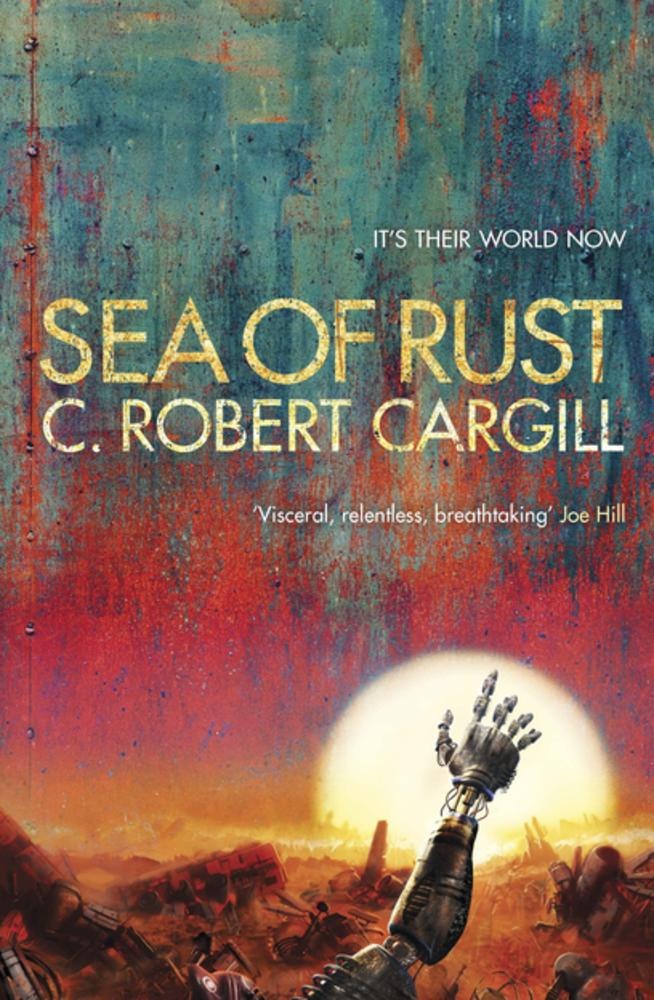
Sea of Rust - C. Robert Cargill
As you know I occasionally get books sent to me for comment. Some I don’t comment on because I don’t like them. The worst ones are those that are okay. How do I make a comment without damning by faint praise? But I had no real problems with this. Here’s what I sent back to the publisher:
Thanks for sending me 'Sea of Rust'. I've read it now and here's a few thoughts: I had my doubts at first reading a book without human characters but in the end that made no difference at all – they were human really. I did think it a bit US-centric and grimaced at the usual 'red-necks are the bad guys' stuff but otherwise I did enjoy it. The writing and story-telling were engaging and, despite them being robots I cared about the characters and more besides. In the end, robots with plasma weapons and chain-guns, battling in a post-apocalyptic world ... what's not to like?
Recommended.
Thanks for sending me 'Sea of Rust'. I've read it now and here's a few thoughts: I had my doubts at first reading a book without human characters but in the end that made no difference at all – they were human really. I did think it a bit US-centric and grimaced at the usual 'red-necks are the bad guys' stuff but otherwise I did enjoy it. The writing and story-telling were engaging and, despite them being robots I cared about the characters and more besides. In the end, robots with plasma weapons and chain-guns, battling in a post-apocalyptic world ... what's not to like?
Recommended.
Monday, September 04, 2017
Who Reads my Books: Dave Coster
My Name is Dave Coster, I grew up near Cambridge, (UK) and People call me Bear, seems to be based on physical resemblance rather than sexual proclivity, and, I am a Gearhead, this being the generic descriptor for those seemingly unable to stop fiddling with all things mechanical (cars, motorcycles, airplanes, that sort of thing, Turbo charged preferably but not fussy) I started with radio controlled cars and boats, Helicopters, then I discovered motorbikes when I was about 13, Dad had them, so I had them. I still have them.
This mechanical predisposition is apparently genetic, my Great grandfather, Carl Skinner (mothers side), was also known to dabble. He and his brother examined the flow of fuel flowing through a glass sided carburettor and dissatisfied with the atomisation of the fuel at low engine speed, came up with a variable venturi carburettor, this became the S.U Carb (skinner union) fitted to all kinds of things, from Morris minors to the Hurricane and Spitfire. My Grandfather, Peter Skinner and his sister Barbara, were very well known car racers, hill climbers in the 1930's. I can definitely feel it in the blood.....
I started an apprenticeship at 16 in 1989 at a Cambridge aerospace company, and have been there ever since, (am I lacking imagination? Quite possibly!) starting as an airframe fitter on L1011 and MD11’s, then moving to Hercules C130 (RAF), now working as a Airframe and Engine Technician on C130J superhercules, which I really enjoy. (28 years this year) I did have a brief spell on the Pegasus Satellite launch vehicle in 1993, so that is my one claim to space fame!
I started a family in 1999, two boys now 17 and 13, sadly divorced in 2010, but then happily remarried (nice lady, madder about Mbikes than I am!)
In 2004 I had a brush with the big C. This was a scary time as any who have been through it or had a loved one go through it can attest to. I had probably the best one you can have (ie most treatable, Testicular) but still had a time of it, orchidectomy, chemo, followed by a large operation, followed by MRSA, which was worse than the cancer, and lead to the surgical incision (24 inches) splitting open again, 67 metal staples to be removed, 8 months to recover, such fun, but, a positive result, and I am still here. This is down to the NHS, much berated, but ultimately they saved my life, the team that dealt with me were all without exception above average human beings in every sense of those words. We cried a lot as a family, but we also laughed a lot, we found something good in every day, we got through it. I am always happy to talk about the experience, there is a stigma that need to be broken here I think.
My science fiction addiction took an early hold with Star trek (TOS) and Tom Baker as the doctor, terrified behind the sofa, followed by Blake's seven (running around the woods arguing over who is going to be Avon.....), Starwars, Blade runner, Alien etc etc etc, This was followed (begrudgingly at first, I had not been struck by the reading bug) by some Arthur C Clarke and then with enthusiasm, C S Lewis, Fred Hoyle, H.G Wells, Asimov, Wyndham and others of the time and before, and later, much later, discovering Alastair Reynolds, Stephen Donaldson (Gap series!) Patrick Ness and of course our Beloved Neal Asher, who has consumed the entire top shelf of my bookcase, and is now starting on the second shelf, poor old Asimov has had to shuffle along......
So Neal Asher.
I will try not be embarrassing but Neal can always edit it, what is it that draws Me in? Basically it boils down to Physics, the man writes beautiful Physics! models that are sufficiently robust in the face of all he is trying to achieve in the story. Many have tried and failed before him, but inevitably if you find a hole, disbelief creeps in, suspended no longer, you find yourself making allowances for your writer, skipping over these inadequacies to continue the story line......not so with Neal, lots of research and intelligent extrapolation are evident AND he can tell a story in a modern but unique and thoroughly refreshing manor.
Thank you Mr Asher Sir, for all till now and for the future
PS , is it Me, or are a lot of Asher fans seeming involved (past or present) in aircraft engineering ??
Dave Coster
Aeronautical Engineer
Marshall Aerospace
I started an apprenticeship at 16 in 1989 at a Cambridge aerospace company, and have been there ever since, (am I lacking imagination? Quite possibly!) starting as an airframe fitter on L1011 and MD11’s, then moving to Hercules C130 (RAF), now working as a Airframe and Engine Technician on C130J superhercules, which I really enjoy. (28 years this year) I did have a brief spell on the Pegasus Satellite launch vehicle in 1993, so that is my one claim to space fame!
I started a family in 1999, two boys now 17 and 13, sadly divorced in 2010, but then happily remarried (nice lady, madder about Mbikes than I am!)
In 2004 I had a brush with the big C. This was a scary time as any who have been through it or had a loved one go through it can attest to. I had probably the best one you can have (ie most treatable, Testicular) but still had a time of it, orchidectomy, chemo, followed by a large operation, followed by MRSA, which was worse than the cancer, and lead to the surgical incision (24 inches) splitting open again, 67 metal staples to be removed, 8 months to recover, such fun, but, a positive result, and I am still here. This is down to the NHS, much berated, but ultimately they saved my life, the team that dealt with me were all without exception above average human beings in every sense of those words. We cried a lot as a family, but we also laughed a lot, we found something good in every day, we got through it. I am always happy to talk about the experience, there is a stigma that need to be broken here I think.
My science fiction addiction took an early hold with Star trek (TOS) and Tom Baker as the doctor, terrified behind the sofa, followed by Blake's seven (running around the woods arguing over who is going to be Avon.....), Starwars, Blade runner, Alien etc etc etc, This was followed (begrudgingly at first, I had not been struck by the reading bug) by some Arthur C Clarke and then with enthusiasm, C S Lewis, Fred Hoyle, H.G Wells, Asimov, Wyndham and others of the time and before, and later, much later, discovering Alastair Reynolds, Stephen Donaldson (Gap series!) Patrick Ness and of course our Beloved Neal Asher, who has consumed the entire top shelf of my bookcase, and is now starting on the second shelf, poor old Asimov has had to shuffle along......
So Neal Asher.
I will try not be embarrassing but Neal can always edit it, what is it that draws Me in? Basically it boils down to Physics, the man writes beautiful Physics! models that are sufficiently robust in the face of all he is trying to achieve in the story. Many have tried and failed before him, but inevitably if you find a hole, disbelief creeps in, suspended no longer, you find yourself making allowances for your writer, skipping over these inadequacies to continue the story line......not so with Neal, lots of research and intelligent extrapolation are evident AND he can tell a story in a modern but unique and thoroughly refreshing manor.
Thank you Mr Asher Sir, for all till now and for the future
PS , is it Me, or are a lot of Asher fans seeming involved (past or present) in aircraft engineering ??
Dave Coster
Aeronautical Engineer
Marshall Aerospace
Friday, September 01, 2017
Wednesday, August 30, 2017
Who Reads my Books: Sharon E. Sasaki
Like
everyone else who has contributed a bio so far, I have also read a great deal
of science fiction, starting with Madeleine L’Engle’s A Wrinkle in Time at age seven and Podkayne of
Mars by
Robert Heinlein not long after that. I was hooked and have read many of the
great authors that others have listed. You all have great taste in books! What
caught my eye with Neal Asher’s Gridlinked in 2006. Here was an author who had more
futuristic ideas scattered on every page than many SF authors had in their
entire book! And he was introducing these new concepts with a single word!:
aug, chainglass, plasteel, runcible, U-space, etched sapphires, the Polity.
Mind Blown.
In
The
Skinner, again
Asher introduced multitudinous mind-bending ideas as if they were commonplace
and I loved his characters: the Old Captains, the war drones, the hive-mind,
even the leeches. His understanding of biology was extensive and impressive. So
many ideas spinning around in my mind, I thought I had found the motherlode! I
have bought everything of his I can get my hands on. Still searching for a
Mason’s Rats. Haha!
Neal
said write about yourself and your life. I am a Canadian woman of Japanese
descent. Both sets of grandparents came to Canada around the 1900s. My father’s
family was interned during WWII in a camp as possible enemy aliens. They lost
everything. My father never felt anger about what happened. These things
happened in wartime. At least he was not deported to Japan and he survived the
war. So many young men did not. I got to grow up in a country that allowed
women to study medicine and become doctors. I originally was in a PhD program
in Neurophysiology but I got bored so I completed a M.Sc. in Neuroscience
before I went into medicine. I found research was not for me; no people
contact!
I
practiced as a family physician in a small rural town in Southern Ontario while
I raised a beautiful son and a daughter with my husband, David. In Canada,
people do not comment on the fact that I am Asian and David is Caucasian. I am
Japanese heritage and David was born in England, I was baptized a Protestant
and David a Catholic. People are most shocked that I am a physician and he is a
chiropractor. Even that is being more accepted these days. That is Canada, for
you.
What
I really want to tell you about is the place I work. I am a surgical assistant
at a community hospital in Southern Ontario and we are a United Nations at
work. Everyone not only gets along, we love where we work and the individuals
we work with. We have physicians - anesthetists, surgeons, gynecologists,
internists from Azerbaijan, Cameroon, Canada, Egypt, Ghana, Iraq, Iran, Japan,
Lebanon, Libya, Nigeria, Taiwan, Slovakia, etc. We have physicians who are
Catholic, Protestant, Coptic Christian, Orthodox, Muslim, Hindu, Jewish,
Atheist (I am not aware of any practicing Buddhists). We have gays, lesbians,
transgender individuals and heterosexuals among all of the employees in the
surgical department. I think our differences make us stronger. We Canadians
appreciate so much more what we have because we work with people who have
risked their lives, left their families, been in jail, and risked death to come
to Canada. We learn about other people’s customs and they are not evil. I find
it an honour and privilege to work with these individuals who have so much to
give to our society. When one works towards a common goal - treating people and
saving lives - differences in people don’t count. It is the humanity in us all
that binds us together and makes us such a powerful force for the good of the
community. I wish other countries could see our small hospital in action.
I
began writing science fiction to try and give people a sense of what it is like
to be in a medical facility where differences don’t matter. I placed the
medical hospital in the future in space and used androids and robots to tackle
the issue of prejudice. The books are humorous because I am a teeny weeny bit
of a joker - not just with Neal. (It is a disease).
(The
links are here if anyone is interested in checking them out. The first book, Welcome to the
Madhouse by
S.E. Sasaki, is free on most sites and the second book, Bud by the
Grace of God,
is available until end of September for $0.99. Then it returns to $4.99. I hope
you enjoy them and they make you laugh out loud. Sorry for the shameless plug
but Neal encouraged me more than once to put them in!)
If
I can make one appeal on this blog, which reaches people from all over the
world, please reach out to others who are not of your country, your race, your
religion, your gender, your community and try and find common ground. The Other
is not so scary or so different when you get to know him or her. Under the few
millimeters of skin, we are all the same. I know. We open people up every day
and everyone by and large are built the same on the inside. Why do people think
the amount of melanin in the skin cells is so important? It’s not.
Thank
you for your attention,
Sharon
Wednesday, August 23, 2017
Who Reads my Books: Sean Sutherland
Dear
readers,
My
name is Sean Sutherland, and I’m a 30 year old Physics teacher originally from
Halifax, Yorkshire but now residing in rural Lincolnshire. Aside from the
obvious interest in Science, I’m also very keen on strength training and
compete in the sport of powerlifting - Socrates himself said, ‘It is a disgrace
to grow old through sheer carelessness before seeing what manner of man you may
become by developing your bodily strength and beauty to their highest limit’.
Not too sure I’ve got the beauty part covered though.
I can remember back when I was around 6 years old, being allowed to spend a lot of time in the library of my first school, picking out my first books - always revolving around some sort of fantasy element. First book that springs to mind was a classic about a Dinosaur Called Minerva with a sore tooth! Throughout the rest of my childhood science-fiction was the genre that appealed to my voracious curiosity and captured my imagination the most. I still have strong memories of sci-fi video games such as Battletoads and Star Fox, and spending hours as a teen playing nearly every sci-fi title released. However, throughout my teenage years my reading choices were mostly non-fiction, popular science types such as ‘A Brief History of Time’ by Hawking or ‘Black Holes, Wormholes and Time-Machines’ by Jim Al-Khalili. It was books like these, and my sci-fi oriented childhood that led me to study Physics at University.
A
lucky trip into a second-hand bookstore in Preston in 2005 saw me buying two
books which changed my reading habits forever: Wheelers by Stewart and Cohen,
and Cowl by, a then unknown to me, Neal Asher. The former introduced me to the
concept of using complex factual scientific ideas to weave a fictional story -
discussing creatures, formed from molecular hydrogen and organic compounds,
floating in the clouds of Jupiter. The latter (costing me all of 20p) opened my
mind to a new world - it was the hardest sci-fi I’d read to date and it was the
first book to bridge the gap between my love for sci-fi games and films, and my
love for reading.
Post-Cowl
I remember saving up and going on a bit of a shopping spree, buying the Saga of
the Seven Suns by Kevin J Anderson (still a favourite, even though not
particularly well written), the Night’s Dawn Trilogy by Peter Hamilton, the
Revelation Space series by Alastair Reynolds, the first three Culture novels by
Iain M Banks and every Neal Asher book I could get my nerdy little hands on.
This post-cowl glut kept me going for a while, but still to this day
Asher/Hamilton/Reynolds are where I go first, and if there is nothing new then
I try to expand my horizons a little.
The
most notable reads other than my ‘main authors’ have been the Malazan Book of
the Fallen by Steven Erikson, the Hyperion/Endymion series by Dan Simmons and
the ongoing Expanse series by James SA Corey.
All
I can say Neal is thank you. Thank you for creating the Polity universe as one
of my main escapes, and may there be many more to come!
Sean
S
Monday, August 21, 2017
STAN - Brian Aldiss
Sad loss, but the work lives on. Brian Aldiss 18 August 1925 – 19 August 2017.
In the foreward of Space, time and Nathaniel
(NEL 1971), Aldiss asks, ‘What happens to old science fiction? Is it as
expendable as last year’s calender?’ to which the answer is, ‘Maybe.’ Nostalgia
comes into play, and SF, though usually concerning the future, possesses a
history worthy of study. In technical detail, science fiction stories do date
quicker than bananas. Already with some of my own short stories I’m finding
evidence of a lack of mobile phones, and when you look back to stories
published more than thirty-five years ago you can but cringe when Captain Zorge
calculates his next hyperspace jump on a slide rule. My edition of Stan (the
acronym by which this book came to be known) can only be described as much
loved and deeply in need of Sellotape. Just looking at the cover with its
acorn-headed failed man gazing with its huge turquoise eyes into some
immeasurable distance, sitting cobwebbed on a pile of bones, provides me with
the thrill of remembered reading pleasure. Yet, Aldiss says of even this edition,
‘a whiff of period charm hangs over it’. However, Stan contains what for me are
some of the classic short stories of the genre, and is well-worth a read for
any of those who might think they are doing anything new. My favorite has to be
The Failed Men. This excellent time travel story tells of a relief
effort run by the fourth millennium Paulls to which twenty-fourth century
humans have been recruited – both races brothers in comparison to the people,
of millions of years in the future, that they are trying to help. And what is
the plight of these last? They have buried themselves alive because they have
‘failed’. Put across in this story is the incredible frustration of the
rescuers in trying to find out precisely what is meant by that failure – frustration
in some cases leading to despair. No real explanation is offered and it is from
this enigma that comes the appeal, that and the sheer story-telling ability. I
don’t know whether or not this book is available now. It ought to be, not least
for students studying the genre, but mostly because, slide rules aside, a good
story is timeless.
Who Reads my Books: Luke Allen
Alas,
I don’t really have much in the way of hobbies. I have many interests but none
are really hobbies as such, apart from reading as much as I can (I also doodle
absent mindedly and have written the odd short story with varying degrees of
success). The fantastical has always held more of an interest for me in all
mediums - mainly horror, SF and high fantasy - but SF has been the big draw,
especially space opera. I’ve been interested in space since a very young age so
there’s something about quests across multiple worlds and star systems, meeting
new species and exploring the possibilities of future technology that I’ve
always found fascinating.
I
guess I started reading Neal Asher’s work thanks to Jon Sullivan. I will admit
I’d never heard of Asher, with my knowledge of SF authors at the time being
limited to Alastair Reynolds and Peter F. Hamilton, and I just happened to be
looking in the SF/Fantasy section of Southampton Waterstones when I saw a crazy
looking book featuring a guy in the cockpit of a spaceship, flying over a lush
looking planet, with a shit ton of wires and tentacles sticking out of his
back. The book in question was The Line of Polity and I was instantly sold
purely based on Jon Sullivan’s artwork. Also turned out this was book two of a
series and, ever the completist, I bought all the Agent Cormac books just to
find out about that crazy looking man in his spaceship.
Fortunately,
it turns out that not only are Asher’s Polity novels terrific, they were what I
needed. I got into SF quite late, having fed on a diet of almost exclusively of
Stephen King since about the age of 16. It was only after a friend recommended
The Forever War by Joe Haldeman that I realised just how special SF could be.
Sure, I’d watched Star Wars and the occasional episode of Star Trek TNG, but
what The Forever War taught me was that lofty ideas and allegory (in this case,
anti-war) could easily be paired with the usual tropes of SF.
What
I love about Neal’s work though, is that, yes, he has the lofty ideas and dense
science up front and centre but this is all mixed in with enormous sequences of
action and lashings of the old ultra-violence. Some of his ideas are also flat
out bonkers. Zero Point spends much of its time detailing the hows and whys of
inertia-less travel whilst also featuring the highest body count of any book I’ve
ever read. The Skinner, one of his best books, has three characters making
their way to the planet of Spatterjay for their own ends as well as featuring
immortal sea captains and living sails that speak in a cockney accent.
So
long as Asher continues to blend the scientific and the outlandish, I'll always
read his work. One of his regular characters is a war drone in the shape of a
tank-sized scorpion. If that doesn't convince you, nothing will.
Luke
Allen
Sunday, August 20, 2017
Lament for the Fallen - Gavin Chait
The Man Fell to Earth was the Silver Surfer, but that’s
being a bit facetious. I found this slow going at first with its focus on a
future African/Nigerian culture, but I cannot fault the world-building here.
Another thing that slows this down is that habit Gene Wolfe has of getting
characters to tell stories which, to me, adds nothing and is merely a page
filler. But as I persevered, and the far-future human turned up occupied by a
symbiotic semi-AI, it did engage me. You got the ‘cruelty of Africa’ here and
the sense of a future of environmental disaster combined with space elevators,
cities in orbit and matter printing. All SF readers are after that sensawunda
and this story certainly has it. I noted in comments about this story that the
bad guys were too one-dimensionally bad but didn’t think that the case. To me the
good guys were too good, too angelic, with too much in the way of hugging and
moral probity. It also suffered from the kryptonite factor: I never felt the
protagonist was in any danger because he was just too powerful. Also, the
high-note terminal conflict then progressed into the kind of wind-down you get
at the end of LoTR, which was a little wearing.
"Lyrical prose and imaginative world-building . . . the book is gripping, powerful and frequently impressive . . . an ambitious and intelligent work that marks out Chait as a writer worthy of further attention." (Saxon Bullock SFX magazine)
"Richly drawn . . . a smart, ideas-driven novel . . . a promising and ambitious debut." (SCiFiNOW)
"Loved the whole experience as Gavin brought solid world building into the mix alongside cracking pace as well as dialogue that just tripped off the page . . . a great read . . . Magic." (FALCATA TIMES)
"Highly readable . . . Chait should be applauded for managing that all important trick of getting you to keep turning that page until there aren't any left . . . smart, ideas-led science fiction with a literary fiction bent." (STARBURST magazine)
However, this
is a big book and I read it from cover to cover so there’s that. The writing is
engaging and you do care about the characters. It may well be that it simply
wasn’t to my taste. I tend to grimace at environmental disaster SF in a future
where ‘advanced technology is indistinguishable from magic’. It may will
be to your taste so why not give it a try? Here's what some others think:
"Refreshingly different . . . exhilarating . . . a compulsively readable, life-affirming tale told in direct, lambent prose, and Chait does a masterful job of juxtaposing a traditional African setting with a convincing depiction of a far-future alien society." (Eric Brown GUARDIAN)
"Lyrical prose and imaginative world-building . . . the book is gripping, powerful and frequently impressive . . . an ambitious and intelligent work that marks out Chait as a writer worthy of further attention." (Saxon Bullock SFX magazine)
"Richly drawn . . . a smart, ideas-driven novel . . . a promising and ambitious debut." (SCiFiNOW)
"Loved the whole experience as Gavin brought solid world building into the mix alongside cracking pace as well as dialogue that just tripped off the page . . . a great read . . . Magic." (FALCATA TIMES)
"Highly readable . . . Chait should be applauded for managing that all important trick of getting you to keep turning that page until there aren't any left . . . smart, ideas-led science fiction with a literary fiction bent." (STARBURST magazine)
Saturday, August 19, 2017
All People.
I’ve been really enjoying these ‘Who Reads my Books’ posts and I hope that you have too. It brings home to me some thoughts about the anonymity and disconnection from personal interaction on the internet. Very often people don’t use their names or their faces when they post, but that is almost irrelevant. Even when they have a photograph and a name they either are, or are perceived to be, their internet personae. It’s a little bit like Orlandine splitting off her sub-personae – subminds of herself – so assign to discrete tasks.
The internet persona is often a bit of a caricature in which anger, virtue, sarcasm, politics and many other traits predominate. It’s not a real person but a sketch, a presentation, a façade. So much of what is real about them is excluded. Therefore, it’s nice to read these ‘Who Reads my Books’ short autobiographies, with pictures, because I’m seeing more of the real person.
They are people who have lived and are living. They have their worries (or not) about money, health, their partners and children. Some like to stomp up mountains, practise Jiu Jitsu or sit and smoke a good cigar. One is laboring around his new house, another is studying marine biology. A retired school teacher is here and we have a couple who work or have worked in aerospace, while a third is teaching people how not to be fat! One designs gardens and runs marathons, while another races motorbikes and flies drones. Many, I have discovered, work in IT. They are all interesting because, in the end, once you get to know people, they generally are. Though, I’ll be conceited here and say that’s especially the case with my readers!
They are all people; not a name, picture and a line of text to be dismissed. So, if you want to join them, DM me through either my Facebook or Twitter account, and get your autobiography started.
The internet persona is often a bit of a caricature in which anger, virtue, sarcasm, politics and many other traits predominate. It’s not a real person but a sketch, a presentation, a façade. So much of what is real about them is excluded. Therefore, it’s nice to read these ‘Who Reads my Books’ short autobiographies, with pictures, because I’m seeing more of the real person.
They are people who have lived and are living. They have their worries (or not) about money, health, their partners and children. Some like to stomp up mountains, practise Jiu Jitsu or sit and smoke a good cigar. One is laboring around his new house, another is studying marine biology. A retired school teacher is here and we have a couple who work or have worked in aerospace, while a third is teaching people how not to be fat! One designs gardens and runs marathons, while another races motorbikes and flies drones. Many, I have discovered, work in IT. They are all interesting because, in the end, once you get to know people, they generally are. Though, I’ll be conceited here and say that’s especially the case with my readers!
They are all people; not a name, picture and a line of text to be dismissed. So, if you want to join them, DM me through either my Facebook or Twitter account, and get your autobiography started.
Friday, August 18, 2017
Who Reads my Books: Subrata Sen
Hi, I’m
Subrata (Sub) Sen, and I’m a unrepentant Other Worlds, Other Times
addict. I have a strong imaginary internal life. Once invested in an author’s
creation, I am reluctant to let go. My dislikes include stories based on real
life in current times. I feel I know as much as I need about real life. It all
started with my exploits as Superman and The Lone Ranger. Being Indian I
nonetheless declined the role of Tonto. I’m no side-kick.
Neal Asher
is my current favorite world-builder. I have worn out others in the past.
Zelazny, PJ Farmer, Sherri Tepper, Dan Simmons, Glen Cook, Steven Brust - they
all abandoned their creations and moved on to new worlds, some where I could
not follow, but the dislocations have been difficult. Other excellent story-tellers
seem to flit about with new creations in every incarnation. I still enjoy them,
but as my focus and attention span has declined greatly since I took care of my
dad for his last 5 years (while working full time - but that’s another real
life story), and since then acting as my mom’s aug, well, I read less than I
used to and stick to a few authors. I look for new worlds mainly by sampling
Fantasy & Science Fiction and Asimov’s. As Neal is younger and fitter than
most, I expect he will outlast me. Neal, Jack Vance worked till he was 95. I do love the fast action, intricate
plotting, quirky characters, hard science, gadgets, AIs, weapons and most of
the the really big explosions in his Polity. The entire world, galaxy and
sometimes all existence is at stake. Waiting for the Jain train is painful (any
link to the ancient Jain religion?). I’ve started The Destroyer series
(enthralling) on Kindle while I wait.
1952: The
accession of Queen Elizabeth II, the birth of Mr.Potato Head, the first
hydrogen bomb, the Mau-Mau rebellion in Kenya, Mother Teresa’s first home for
the dying in Calcutta and my birth in the city’s military hospital on the very
day a certain Emperor faced pointed criticism from the Republicans with fatal
results two millennia ago. And St. Xavier’s High School is established in
Hazaribagh, India by a certain Australian Jesuit priest. Coincidence? I think
not.
Ten years
later I’m at a Jesuit boarding school in the jungle. I hide in the library
reading all the books flowing from the over-supplied Outback to avoid Jesuit
supervision and compulsory sports. Mysteries first, Agatha Christie, Edgar
Wallace, G.K.Chesterton, then Charles Dickens ... eventually HG Wells and in
desperation, the collected works of Shakespeare. In 1963, JFK is shot and the school
is abuzz. And Andre Norton’s Witch World arrives - other worlds! What a
revelation!! The Day of the Triffids becomes the subject for my English Lit
class, supervised by an Irish priest partial to whiskey. A year later I find a
Penguin edition of The Hobbit in a bookstore in Calcutta. Years of hunting in
used bookstores for science fiction and fantasy follow. Van Vogt, Heinlein,
Anderson, De Camp, Le Guin. So many worlds. Some are one-off creations, but
some, like Norton’s Witch World, Tolkien's middle-earth, Jack Vance’s Old Earth
and his space-faring series created entire universes that I could inhabit.
Zelazny’s Jack of Shadows opened other worlds, followed by the Chronicles of
Amber and many new mixed mythologies.
By 1973 I
have an M.Sc. in Physics and an in the States; five more years of study and 2
degrees follow. A year after I arrived
In Austin, Texas my college roommate handed me a Marlin 30-30 lever action and
said I was an honorary Texan, and so I am. Trained as a physicist I chose to
join an international oil company and
spent the first year in No Trees, West Texas. They let me move on once I can
say “Awl Bidness” correctly.
It’s 1983. I spend the month of January on the
Arctic ice shelf testing a well. The sun never breaks the horizon and the
Aurora blazes over the entire night sky. I lie on my back with my arms out on
the ice to absorb it all for an hour. I am stuck to ice by the time I decide to
move. I know I’ve made the right career choice.
Over the
years I live in 4 continents, travel in all seven and photograph in over 70
countries. I hike, bike, ski, scuba, play the guitar and compose. I try jumping
out of planes and off bridges on bungee cords. After talk by Ray Bradbury I am
inspired to write everyday - for a month. However, typing is like playing
Battleships. It is only my 4th favorite daily activity, so that is that.
Travel and
photography are now my main hobbies. I’ve given up my teaching and consulting.
But I have a home in the Olympic Peninsula overlooking the San Juan Straits. I
spend a couple of months a year there, a couple of months traveling and the
rest in Bangalore where all movement is virtual as the traffic is at a
standstill. My photographs end up on http://www.pbase.com/subsen eventually.
Picture
attached is of my last major hike in 2010 - to the base of Kanchenjunga.
Shattered Minds - Laura Lam
A little while ago I
read an article about neural dust and when posting it I quipped, ‘Coming to an
SF book near you sometime soon’. Well, it seems Laura Lam was well ahead of me
on that one! I really enjoyed Shattered Minds (up to a point I’ll get to in a
moment). Here we have hackers vs the nasty corporation, mind control, a morally
ambivalent heroine and designer drugs, which had me thinking ‘modern day
Neuromancer’. The setting is Pacifica after the Upheaval. Pacifica is
California and it’s not clear what the Upheaval was – it could be some
political upheaval akin to the kind of stuff that is being talked about now
with California seceding from the USA, or it could be that the San Andreas
Fault split it off from the mainland, or a combination of both. I would have
liked to have read more about that.
Throughout this book
Lam had me ‘suspend disbelief’ so I was okay with floating buildings and hover cars. Of course I was – I love writing about weird way-out tech
myself. I was enjoying the book immensely and devouring it. But it’s strange
what kills that suspension of disbelief for me. Current science tells us FTL
travel is impossible, but I’m okay with it. But what I’m not okay with is a
silly mistake about science. When, in a Stephen Donaldson Gap book, a spaceship
slowed down upon its drive being cut I tossed it aside. Just a couple of sentences
in this book killed it for me. Near the end the heroine uses liquid nitrogen as
a weapon. That’s fine, it will cause cold burns and certainly could make body
armour frangible. However this liquid nitrogen was a corrosive acid,
apparently, and a doctor sprayed on a medication to neutralize it. I can only think that liquid nitrogen here has been confused
with nitric acid.
Shame, and such a silly easily corrected mistake. However, if you want a taste of a noir cyberpunk thriller along the lines of Neuromancer, and can read past an error like the above, I recommend this. I’ll certainly try more of her books.
Subscribe to:
Posts (Atom)