Showing posts with label Science. Show all posts

Wednesday, February 07, 2018

Falcon Heavy

Watching Elon Musk’s Falcon Heavy launch into space, seeing two of its boosters land with the kind of precision that looked like CGI and seeing, FFS, a Tesla car swinging round Earth with a manikin in the driver’s seat, had me the most excited about space travel and exploration I’ve been for an age. Why is this important? The rockets are reusable, the cost is coming down at an astounding rate but, most importantly, Musk is showing that space exploration and travel can be carried out by private sector enterprise. In fact it can be carried out better. We no longer have to wait for moribund, government-controlled bureaucratic behemoths like NASA to get us into space.


This launch also had another effect on me illustrated by a tweet I saw last night. I paraphrase: ‘There’s a Tesla car heading to Mars and you’re still on about Trump?’ In one evening I completely lost interest in politics and still feel that way this morning (but it will inevitably return).


There was one negative in this and that was the third booster failure. One of its engines failed to ignite (some fuel problem?) and it missed the drone ship to plummet into the sea at hundreds of miles an hour. But even this is a relatively minor mishap in something of this scale. Firstly, other rockets aren’t even reusable and, consequently, are a damned sight more expensive (“The nearest peer competitor is the Delta 4 Heavy at roughly half the thrust and from four to as much as ten times the cost.”). Secondly, it turns out that these rockets won’t be used again anyway since Spacex has the next iteration ready (I think).


There have been naysayers. Some feel that Musk should have sent some scientific instrument rather than a car, and that this was a crass publicity stunt. They have obviously failed to understand the financial aspect of the publicity generated by this stunt. Doubtless their inclination is for science under the aegis of big government, and they find private enterprise distasteful. Another, apparently on TV this morning (I didn’t see this since I don’t have a TV licence and therefore don’t watch live TV) was bemoaning the ‘pollution’ of space and of Mars by sending a car up. Beside the fact that the car will not actually end up on Mars, this is quite ridiculous politically correct ‘environmentally conscious’ virtue signaling. It also shows a complete failure to understand the barren hostile immensity beyond Earth. Seriously, fuck off.


Elon Musk is a man with a dream and he is not buggering about in achieving it. He wants us up in space, constantly, on Mars, on the moon and elsewhere. I love too that he is obviously also a lover of science fiction. Culture ship names and that ‘Don’t Panic’ on the dash screen of the Tesla demonstrate this. And his dream, in the end, has revitalized the dream of space exploration for us all. 


Sunday, March 20, 2016

DO Panic

When I came back to Crete my depression was over but I was still getting anxiety and panic attacks. Over a month it has been standard for me to wake up in the morning, usually very early, lie in bed hoping to snooze again then having a panic attack ensue the moment I started to drift off again. If I stayed in bed these would get worse and worse and when I finally got up I would be in a mess. My technique therefore was to try and get out of bed as quickly as possible. Other times I would get them while going into trance during meditation. Every day I would feel tired and it would take me hours in the morning to get motivated.

Moments of anxiety would also hit me during the day too. I have been fighting this for so long, sometimes thinking I was winning, sometimes sure I would never win.

Three or four days ago I lay down on my sofa and used a Paul McKenna hypnotic recording to relax. I went into trance then into sleep. When I woke up it was to a massive panic/anxiety attack. A whole body one with the skin on my arms feeling hot, my body buzzing, and of course I felt awful. All I could do was lie there and wait for it to pass – until I could get up and start doing things. It later passed but the next morning I had the same routine as above, at 4AM.

Later in the morning I felt so tired I lay on the sofa again, needing to rest but afraid to sleep. I started to doze off and, again, each time I did so, I had a panic attack. But then something happened...
Some days back I did some gardening. I cleared out a couple of composters and started weeding. Just feeling shit and wanting to get the job done. It then occurred to me to be mindful about what I was doing. Instead of letting my mind wander off into worries and negative thinking, which I just let go, I focused completely on what I was doing. Meticulously pulling the weeds, feeling them in my hands, smelling them, really looking at what I was doing – living in the moment. This really started to make me feel better and by the time I left the garden (my fingers cold and stiff) I felt that euphoria of normality.

During this last lot of panic attacks mindfulness kicked in again, and I found myself mentally stepping back from the panic attacks and just observing them with detached interest. The result of this was that I did get some snoozes in and got off the sofa feeling pretty good.

I did some internet research and it seems that all my fighting was the wrong thing to do. The first stage of recovering from panic attacks is ‘acceptance’. Okay, that was right. I then did further research and discovered a seemingly counterintuitive technique. Encourage the attacks. Try to make them worse. Till now I had been trying to stop them. I had some success but just felt more anxious afterwards. Next meditation session, when they came, I really tried to make the attacks worse and what happened was surprising, they withered away.

This morning I woke and did the same thing, and instead of them steadily getting worse as I lay in bed they got weaker and weaker. For the first time in months I actually managed to lie in bed and catch a few extra snoozes, and then get up feeling refreshed. My energy level for the day seemed twice what it has been.

So, win the fight by giving in, by actively helping the perceived enemy. This has never been in my playbook, but it is now.

Wednesday, December 17, 2014

Visit to Glasgow

I took a little trip to Glasgow last weekend or, as my phrase book would have it ‘Glesca’. I thought to myself that well, I’ve got the low fuel consumption diesel Hyundai, so I’ll drive. The car chugged along nicely, but bloody hell, I really ought to take more rest breaks next time! I am also now awaiting the arrival of speeding tickets because it seemed there was no point around the M25 and little way up where the beady eyes of speed cams weren’t observing me. Arriving in Glasgow I stopped in a Premier Inn. Pretty good room, comfortable and spacious, but not exactly cheap.


It was cold and wet up there, but let’s not make this a Scottish weather thing because it wasn’t exactly beaming sun and T-shirt weather in Essex. From the Inn I got a pretty good view of some recognizable structures.


One nearby building was the Science Centre (no picture). The friend I went to see thought this would be ideal for me to visit and quite right too because I like all that stuff, but the place was a laughable disappointment. We got inside and it was like what is this shit? Well, it was all interactive toys for children. And it cost £21 for two people to find that out. We got out of there pretty sharpish and next headed to Glasgow city centre. It was  of course crowded with Christmas shoppers…  


I got a slight nostalgia jolt seeing Glasgow Central Station since that was where I went many years ago to an Eastercon SF convention – held in one of the big hotels. I remembered the authors trooping after their editor like lost ducklings, remembered drinking too much, a painfully stilted authorial lunch and the overpowering urge to stub a cigarette out on the head of some pretentious berk, and escaping into the city for a look around.


One highlight of last weekend’s trip was going to a Angus and Julia Stone gig. I’d never heard of them before a few weeks back, but now they’re growing on me. This is good because even though I’m not heavily into music I do like to listen on occasion. Unfortunately, all the music I have liked over the years has its Caroline connection, and it just makes me miserable to listen to it.


The next highlight was a breakfast at The Rio Cafe, which I couldn’t finish. Included in this (buried under the rest) was my first try of Stornoway black pudding (I’m looking at you Shona McTavish), which was delicious, and I ate the lot of that.


The final highlight was a visit to the Kelvingrove Museum. Free entry and a sight more interesting than that Science Centre.


I particularly liked these heads – appealed to my inner weirdo.  

Wednesday, August 27, 2014

Snakeskin

When the hot dry wind hits here is fries vegetation and heaps the detritus here and there around my garden. The leaves, flower petals and bougainvillea bracts haven’t had a chance to turn brown. It’s like someone has tipped out a few sack loads of potpourri. While clearing these up recently, ever wary of the odd concealed scorpion (though they’re not often about when it’s hot and dry) I found numerous crisp-dried sections of shed snakeskin. Judging by the size of these pieces the snake was three of four feet long. I wish I’d saved them for a photograph but they went in my composter with the potpourri. Only a few weeks after that wind did I pick up one small piece...


...and think ‘USB microscope’!

 
I don’t know whether this will be interesting – let’s find out.
Snakeskin x20

 
Snakeskin x80

 
Snakskin x350

 
Okay, I did find these interesting, but then I have a confession to make: I’m a nerd. Also, coincidentally, when going back to editing these are the first words I read: He gazed at the snake drone locked in its clamps, and at the spine driven in through its mouth and deep into its body.

Monday, May 05, 2014

Fun with a Scorpion

Yesterday when I took my walk to Handras I set out in shorts and t-shirt because the sun was shining and I expected the temperature to just climb, but cloud steadily thickened. As I approached that village I was pretty sure I was going to get rained on and it occurred to me that while I didn’t mind getting a bit wet since it was still warm, the Greek/English lexicon, sheet of paper with Anna’s latest lesson on it, wallet and notebook in my man-bag might not appreciate it. I started looking for a plastic bag, damning myself for not sticking to my idea of always carrying a spare because wherever you go here Greeks will give you gifts of fruit and veg. (I digress: on one of my first walks here a pickup stopped beside me and the old guy behind the wheel waved to the back and held up three fingers. I took three mandarins out of the back, thanked him, and enjoyed them on the way home.)

The first plastic bag I found had fur and other icky substance stuck inside so had probably contained a dead cat. I passed on that one. The next I picked up was clean so I put the vulnerable items in that then back in my man-bag. Rubbish in general, including plastic bags, is never in short supply here and is strangely lacking in the tourist photos. On many occasions I’ve had my Jaws moment while swimming only to see a carrier bag sliding by under water.

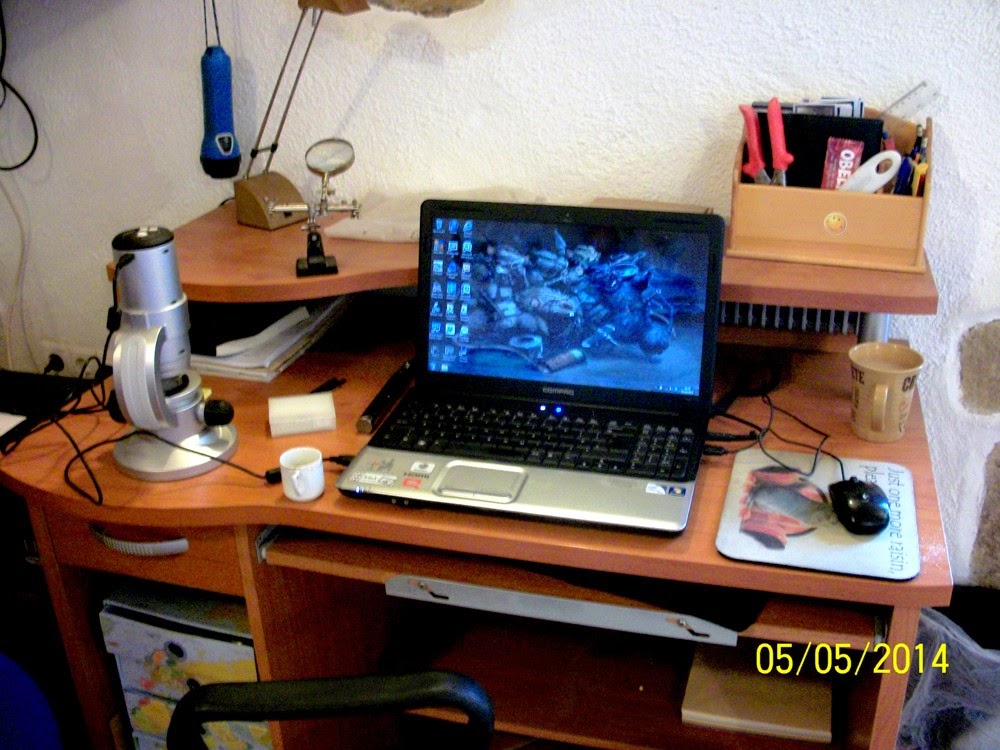
Rumbles of thunder ensued and I did get rained on but not enough to bother me much. Back home, with the weather clearing a little, I set about varnishing woodwork then tidying the garden and other areas surrounding the house. This done I read Greek for an hour before deciding that maybe it was time to fire up that USB microscope that has been sitting on my shelf for 2 or 3 years. I connected it to my laptop, opened camera app, then looked around for the slides. I couldn’t find them anywhere so had to pack the microscope away again and instead watched the Sopranos.

This morning I was determined to make a concerted search for those slides after a walk to Lithines. However, it was grey and pouring with rain and has only eased off now at 9.30. Foregoing my walk I began rummaging through drawers – always traumatic because every item has a memory attached. I threw stuff away and relocated it, then finally found the box of slides in a cobwebby mess behind my desk. Time to set up the microscope again...


Here’s Mr Scorpion in place:

 
And here are some shots of him, respectively the sting, part of the main body and one claw.


This is my first effort. I would have liked a lower magnification so as to get a detailed picture of the whole thing but at x20 this is the lowest of the main settings which then go up to x80 and x350. Here’s x80 on the sting, while x350 is just a difficult blurry mess I won’t bother with.

 
Maybe if I take a series of shots at different points along its body I can paste together a whole picture in one of the other programs I have available? That’s a project for another time. I also need to get hold of the kind of slides I remember from my childhood (when my parents bought me a very good microscope for maybe my 10th birthday). These slides have dished recesses in them so you can put in a droplet of filthy water and watch fascinating diatoms zipping about, and the app will allow me to take video clips of them.

There you go: it is now confirmed that I am a weirdo.

Tuesday, November 05, 2013

SF Prediction

Here's a bit I wrote for a BBC article by Peter Ray Allison:

Science fiction hits some predictive targets in science but rather in the way that a clip fired from an assault rifle will hit some of the enemy hidden in the jungle, but mostly hit trees and leaves.

One of the past criticisms of SF has been that it’s all ‘zap-guns and rocket ships’ whereupon the SF writer can smugly point out the LaWs US navy laser system knocking down drones and then perhaps wax lyrical about the X Prize, Virgin Galactic and Elon Musk’s SpaceX.

Yet, prior to Sputnik and the space race we had SF about space ships with the navigator aboard calculating the ship’s course with a slide rule. Today many people use a communication device much like those used in Star Trek, but the Roddenbury communicator was distinctly lacking in apps, games, camera and video recorder. It’s a simple fact that SF completely missed the computer revolution we have seen, yet, three-D printers we are now seeing have been there in the books for some while, though admittedly running on hand-wavium.

But in the end SF is not there to make accurate predictions about the future. It’s there to entertain and stimulate the imagination. And there is absolutely no doubt that many of the imaginations it stimulates belong to scientists and that to some extent it drives and directs science. I can think of many examples, but offer this one: the X-Prize now being offered for aStar Trek tricorder.

Sunday, March 10, 2013

Anti-Ageing Breakthrough

Well, I didn’t see this is one coming, and really should have. I’ve always felt that life-extension would go in a series of small steps, just as it has been going. There is no cure for cancer as a whole because there are thousands of different varieties of cancer. If a cure or some kind of delaying treatment is found for one kind then that pushes overall life-expectancy up, just a little. Just as if a better way of treating dementia or diabetes is found. Statisticians have a lot of fun with these figures because, with life presently being 100% fatal, if you cure one thing then more people die of another. Next time you hear ‘dementia on the rise’ just remember that is probably because less people are keeling over from heart attacks.

Since 1970 life expectancy in Western European countries has typically risen by six to eight years, and the rate of increase has been 2% a decade. Of course these figures vary hugely across the world and are dependent on numerous factors, but the trend is ever upwards. There are many coffin dodgers would like to try and stay within that slow rise and, unless our civilization collapses, there will be people born in the next 100 years who are just going to keep on living, with no end in sight.

However, even though most of the low-hanging fruit have been picked – consider how much life expectancy must have leapt up when penicillin was discovered – but the possibility of big jumps in life expectancy should not be discounted. And this looks like it might be one of them. Here is a link at Extreme Longevity, and another at Science Daily and lots more can be found if you just google ‘Anti-aging drug breakthrough’.


Publishing his work in the prestigious journal Science, David Sinclair of Harvard reports a breakthrough in the development of drugs that can block the aging process.

The article is entitled Evidence for a Common Mechanism of SIRT1 Regulation by Allosteric Activators, and reveals how interaction with a single amino acid in the SIRT1 enzyme is crucial for the ability of drugs that can activate the enzyme.

SIRT1 is an enzyme in the class of molecules called Sirtuins. Significant research shows that activation of sirtuins  reduces cellular aging through its interaction with other cellular master switches such as FOXO3a and PGC-1a

“At the cellular level,” explain the authors. “SIRT1 controls DNA repair and apoptosis, circadian clocks, inflammatory pathways, insulin secretion, and mitochondrial biogenesis”

The increase in centenarians is well known, but this particular comment caught my attention:

 “Now we are looking at whether there are benefits for those who are already healthy. Things there are also looking promising,” he says. ”We’re finding that ageing isn’t the irreversible affliction that we thought it was,”

“Some of us could live to 150, but we won’t get there without more research,” he adds.

Thursday, February 14, 2013

Cellweld TM

Being back in the Polity now, while reading lots of science articles on the internet, I’m finding that the Polity needs updating in detail. All here have doubtless read stuff about 3D printing of inert matter and even of cells, and this morning my first science article of the day was this over at Singularity Hub:


3D printing technology is hot and getting hotter. Whereas once 3D printers were limited to a few select materials, these days inputs include metal, plastic, glass, wood, and—human cells? Bet you didn’t see that coming. (Actually, if you’re a regular here, you probably did.) Bioprinting firm, Organovo, isn’t anywhere near 3D printing a hand or heart. But a recently announced partnership with 3D modeling software giant Autodesk (maker of AutoCAD) might speed things up a bit.

We first encountered Organovo in 2009. The firm introduced the NovoGen bioprinter in 2010—the first of its kind—and has since built ten more. At a cost in the hundreds of thousands of dollars and as yet only rudimentary capability, bioprinting technology is firmly in the developmental stages.


So, of course 3D printing was invented long before the Quiet War. It’s so common in the time of the Polity that it is hardly worth mentioning that it is precisely the 3D printing above that is used by cell-welders and bone-welders or, rather, I neglected to mention it in the previous books… And, of course, many maintenance robots use 3D printing to repair damaged ships but foolishly, being a 21st century viewer of these activities, I took what they were doing to be welding or some other similar activity, so am now working to correct that:

Here a tic-shaped printer-bot was slowly and meticulously blocking off the tunnel, the numerous jointed printing heads sprouting from its foreparts steadily depositing layers of some white crystalline substance round and round its interior. Trent was reminded of a paper wasp building its nest, and as he eyed those busy printing heads he wondered if they were capable of doing any damage. Perhaps it would be better just hit the thing now… He raised his particle cannon, at which point the robot abruptly retreated out of sight.
‘I’ll go first,’ he said.

Nothing dates quite so fast as science fiction…

Friday, February 01, 2013

Fountain of Youth?

Gob hanging open...

Researchers were able to turn back the molecular clock by infusing the blood stem cells of old mice with a longevity gene and rejuvenating the aged stem cells' regenerative potential. The findings will be published online Thursday, Jan. 31, in the journal Cell Reports.

The biologists found that SIRT3, one among a class of proteins known as sirtuins, plays an important role in helping aged blood stem cells cope with stress. When they infused the blood stem cells of old mice with SIRT3, the treatment boosted the formation of new blood cells, evidence of a reversal in the age-related decline in the old stem cells' function.

 "We already know that sirtuins regulate aging, but our study is really the first one demonstrating that sirtuins can reverse aging-associated degeneration, and I think that's very exciting," said study principal investigator Danica Chen, UC Berkeley assistant professor of nutritional science and toxicology. "This opens the door to potential treatments for age-related degenerative diseases."

Thursday, January 31, 2013

Super Super-Capacitor

I just picked up on this on Singularity Hub. Game Changer?

The Super Supercapacitor | Brian Golden Davis from Focus Forward Films on Vimeo.

What if you could charge your phone, tablet, or laptop in 30 seconds and have it work all day long? That’s the promise presented in a short film titled The Super Supercapacitor that profiles the work of UCLA inorganic chemistry professor Ric Kaner, whose research focused on conductive polymers and next generation materials.


Sunday, January 20, 2013

Zero Point USA

It seems they're using a slightly different cover for the US version of Zero Point, but it's still a Jon Sullivan picture so good stuff as ever. However, they seemed to have screwed up: it's 'Owner' singular...

Update
Jeremy Lassen informs me: That was an early version of the cover that made it into the wild before we fixed the plural thing. The actual books are right, and the incorrect version currently at amazon is hopefully being overwritten this week.

Night Shade Books are publishing The Owner Trilogy in the US and have scheduled The Departure for publication Feb 5, 2013 with Zero Point following May 7, 2013 and Jupiter War  September 3, 2013 (catching up with publication of that last book in Britain). Nicely keying into that my short story The Other Gun will be appearing in Asimov’s April/May issue that year with, of course, mention of these books in attached biog. It should be an interesting year with those three books slamming into the American market in rapid succession. In essence this should work as quite a profile-raising exercise.


Meanwhile here's a Walker of Worlds review of the book:

Asher doesn't fail in making this second volume of the Owner trilogy a step up from The Departure, adding in plenty to keep the pages turning. For those familiar with his Owner short stories there are some nice treats in store, and for those that haven't.... well, what are you waiting for? In short, Zero Point is well worth reading, and I will be very much looking forward to Jupiter War!

Monday, January 14, 2013

Hair Cell Regeneration

Well, after years of working with noisy machinery - up until 2001 I had operated milling machines and lathes for many years then, when I went self-employed, I used mowers, chainsaws, hedge cutters and strimmers - I'm often finding myself mentally replaying stuff that people have said because I didn't hear it properly. At some point, probably in the next ten years, I'm going to need a hearing aid, but damn I would much prefer the damage repaired at its root:

...

In the Jan. 10 issue of Neuron, Massachusetts Eye and Ear and Harvard Medical School researchers demonstrate for the first time that hair cells can be regenerated in an adult mammalian ear by using a drug to stimulate resident cells to become new hair cells, resulting in partial recovery of hearing in mouse ears damaged by noise trauma. This finding holds great potential for future therapeutic application that may someday reverse deafness in humans.

This is the kind of article that undermines my usual pessimism.

Friday, December 21, 2012

The Windy Moon


I caught a bit of Who Wants to be a Millionaire last night and really wish I hadn’t. The question I heard was, ‘Which of these do you find on Earth but not on the Moon?’ and the choice of answers was: sunlight, gravity, craters and wind. I stood there with my mouth hanging open listening to two ‘celebs’ debating whether or not the Moon has gravity, then one of them stating quite firmly that there was wind up there. In the end they made the sensible decision not to commit to an answer and take the money and run.


Now, I really don’t expect people to know the names of the main moons of Jupiter or to even be able to recite the order of the planets in the Solar system, but a little basic scientific knowledge would be good. But then, I was showing a lack of basic scientific knowledge too because they couldn’t hear me while I was shouting at the television.   

Sunday, November 04, 2012

Complete Genomics

Interesting article and video clip over at Singularity Hub...

Reid expects single cell sequencing to be commercially available within two years, and he’s very optimistic about the potential of whole genome sequencing in the fight against cancer. “I don’t think my kids are going to worry about cancer. I think we’re going to nail it in my lifetime. We’re never going to be able to stamp it out [completely] because they are mutations, and mutations are going to happen. But we’re going to be able to treat it. We’re going to turn cancer into a chronic disease, not a death sentence.”

Saturday, November 03, 2012

Gene Therapy


One of our habits/traditions in England has been weekend papers, read in bed (with tea and coffee and cigarettes for a healthy start to the day). Previously we’ve had these delivered but now that delivery costs more than the papers themselves we’ve started going to fetch them. I enjoy a chuckle at Clarkson, read some of the politics, skip over the celebrity stuff then Caroline removes the puzzle pages which we take off to Crete. This morning, out of all the articles about the economy, Europe, whatever, the one that really caught my attention was a small column quite a number of pages in. It was the most important article there and it was about this:

Regulators yesterday approved the first therapy in the western world that can correct errors in a person’s genetic code.

Europe has approved Glybera to be used against a rare inherited disorder which disrupts fat production in the body.

The treatment uses a virus to counteract LPLD, lipoprotein lipase deficiency, which can led to acute inflammation of the pancreas.


I can remember when this was confined to science fiction and the most speculative science articles about what it might be possible to do (Remember that chat between Roy and Tyrell in Bladerunner?). I can remember when this was a future possibility but maybe in ten or fifteen years if massive hurdles could be leapt. This is about changing something as ineluctable as fate: genetic predestination; the hand of cards you were dealt with in the womb and could never change. 

Friday, November 02, 2012

Writing Update: Penny Royal II


Penny Royal II is now past 122,000 words and I’m slowing down a little as I enter the home straight. This is because I have had to go back to alter and add or delete plot elements, even in the previous book, to ensure things lock together. For example, I found it necessary to go back to the start of this book and have a particular entity, with a soft and changing body, undergoing radical surgery to install a ceramal skeleton. Other alterations required are about emphasis. I need to ensure that some King’s Guard warships are seen as very powerful, while an ancient factory station is outdated and vulnerable. I also need to concentrate on the internal life of a particular war drone so the reader understands its motivations.

All this is pretty much a tidying up exercise. When you write fast to produce a massive uproarious story some things fall by the wayside – you drop the ball and have to go back and pick it up. You forget things, like I forgot that a particular prador controlled a number of skeletal Golem, and I also forgot that a Penny Royal Golem is along for the ride. I need to elaborate on how a renegade prador reproduces (incidentally there’s more in this about prador biology and society: prador females, mating, fourth-children). And thinking about the next book, I might have to add something about a black hole and something called ‘the black hole paradox’.

Righto, back to work.

Monday, October 29, 2012

SF Wars


I found some goodies in the post when we got back. Here we have SF Wars edited by Ian Watson and Ian Whates. My story in here, The Rhine’s World Incident, was first published in Subterfuge.


War is becoming increasingly 'SF-ized' with remotely controlled attack drones and robot warriors already in development and being tested. Over the past 100 years the technology of war has advanced enormously in destructive power, yet also in sophistication so that we no longer seem to live under the constant threat of all-out global thermonuclear cataclysm. So what will future wars be like? And what will start them: religion, politics, resources, refugees, or advanced weaponry itself? Watson and Whates present a gripping anthology of SF stories which explores the gamut of possible future conflicts, including such themes as nuclear war, psychological and cyberwars, enhanced soldiery, mercenaries, terrorism, intelligent robotic war machines, and war with aliens.All the stories in this collection of remarkable quality and diversity reveals humankind pressed to the limits in every conceivable way.It includes 24 stories with highlights such as:The Pyre of the New Day' - Catherine Asaro.The Rhine's World Incident' - Neal Asher. Caught in the Crossfire' - David Drake. Politics' - Elizabeth Moon.The Traitor' - David Weber.And others from:Dan Abnett, Tony Ballantyne, Fredric Brown, Algis Budrys, Simon R. Green, Joe Haldeman, John Kessel, John Lambshead, Paul McAuley, Andy Remic, Laura Resnick, Mike Resnick & Brad R. Torgersen, Fred Saberhagen, Cordwainer Smith, Allen Steele, William Tenn, Walter Jon Williams, Michael Z. Williamson, Gene Wolfe.

Monday, February 13, 2012

The Great Stagnation

Starting from here on The Next Big Future I read a few articles and looked at some videos. The book The Great Stagnation which seems to be at the root of all this makes the claim that technological advance is slowing because we’ve already grabbed the ‘low-hanging fruit’. Take for example the car. It is a huge step to go from not having a car to having one. The car was the big invention and everything since has just been innovation – no flying cars have arrived. In a speech he gives the author of the book cites many examples, like the average kitchen and how little it has changed since the 50s, but he then reluctantly admits that there have been some big advances in communication (Internet, mobile phones etc.).

Apparently, the low hanging fruit having been grabbed means that the average American is half as wealthy as he would have been had the advances been continuing at their previous rate.

Firstly, I don’t buy the distinction between invention and innovation since the car is just an innovation of the horse and cart and can be traced back to Shanks’ pony and the simple need to get from A to B. I sort of buy the ‘low hanging fruit’ argument but in the end that is really a value judgement. Is the invention of the car more important than the invention of the mobile phone? Is it more important than the accumulation of medical inventions/innovations that have extended our lives by decades? Is it more important than sequencing genomes at an increasing rate, biotech that makes it possible to make yeast that produces diesel or our growing nanotechnology? You see what I mean: a value judgement.

And, like many who have been discussing this book, I don’t agree that a slowing of technological advance is why people aren’t as wealthy as they could be. Firstly I don’t agree that technological advances are slowing. I would say that their effects are taking longer to reach us because of an increasingly hysterical anti-science meme that has spread in the West, with its resultant increase in restrictive legislation. Secondly I would say that the decrease in wealth relative to those advances is all due to increasingly parasitic governments and financial institutions sucking up that wealth – wealth that would have been used to develop those technological advances. Invent something astounding and you need big bucks to get it to market from under the leaden hand of government legislation. You don’t have big bucks of your own to spare because government and the financial institutions have stolen them. It’s an increasingly vicious circle.

This is why you see no technological singularity in The Departure – the parasitic state has killed innovation and invention. My only hope, in the real world, is that the financial collapse we are entering now will kill off some portion of the parasite infestation before the host dies. But even if that does happen, the host will still need time to recover its health, and the problem is that parasites grow faster than their hosts. 

Saturday, February 11, 2012

Sooty Moths

Funny, I was waffling on about natural selection and evolution to Caroline the other night (after watching a program about how plants altered Earth) and the example I chose was the peppered moth. Today I found myself reading an article on just that. It never occurred to me that the process went into reverse after the clean air act.


I have to add that this is one of the best current proofs of the theory of evolution/natural selection going.

Thursday, February 02, 2012

Daily Parasite

Just a recap here for those who maybe don’t know: While I was climbing up the SF-writing ladder, in fact, if I recollect correctly, when I was working on The Parasite for Tanjen Books, I ended up chatting to the mother of a friend. Now, both the mother and father of said friend were smart cookies – both were vets. She gave me some advice on punctuation that has stayed with me ever since, but she also loaned me a veterinary book on helminthology, which is the study of parasitic worms.

I was at once fascinated. Firstly the book reminded me of books my mother had studied during teacher training and which I pored over as a child, what with their anatomical pictures or internal organs, musculature, skeletons etc.

(Oh, on a side note that was very much a formative period of my life: as her main subject in teacher training she studied mycology (fungi) which, for a kid, was great. Not only did we go to woodlands hunting for these weird and wonderful things but we could also eat them, which appealed to the hunter-gatherer in me. Now I can identify quite a lot of British fungi and of course this interest led to mycelia … which led to Jain tech)

Secondly, I found the intricate life cycles of these creatures fascinating, just as I was boggled by the way they could manipulate or physically change their hosts. Some of this went into The Parasite, an awful lot of it went into short stories: The Thrake, Cave Fish, Choudapt, Putrefactors, Spatterjay, Snairls and Shell Game to name but a few. Then, of course, when it came time for me to write a book after Gridlinked I picked up two of those short stories – Snairls and Spatterjay – and used them as the launch pad for The Skinner and the two ensuing books.

So what am I waffling on about? Well, the above is why I was so glad Vaude passed on the link to Parasite of the Day (thanks Vaude). This is just my kind of stuff. I am almost certainly going to read every article on that site. Also thanks to Dr Tommy Leung who has just changed the black background of that site to make it easier to read!


Oh, and some character in my books has definitely got to be hit by a weaponized version of the above. I can see him/her dying horribly while sprouting mushrooms.